Recent articles
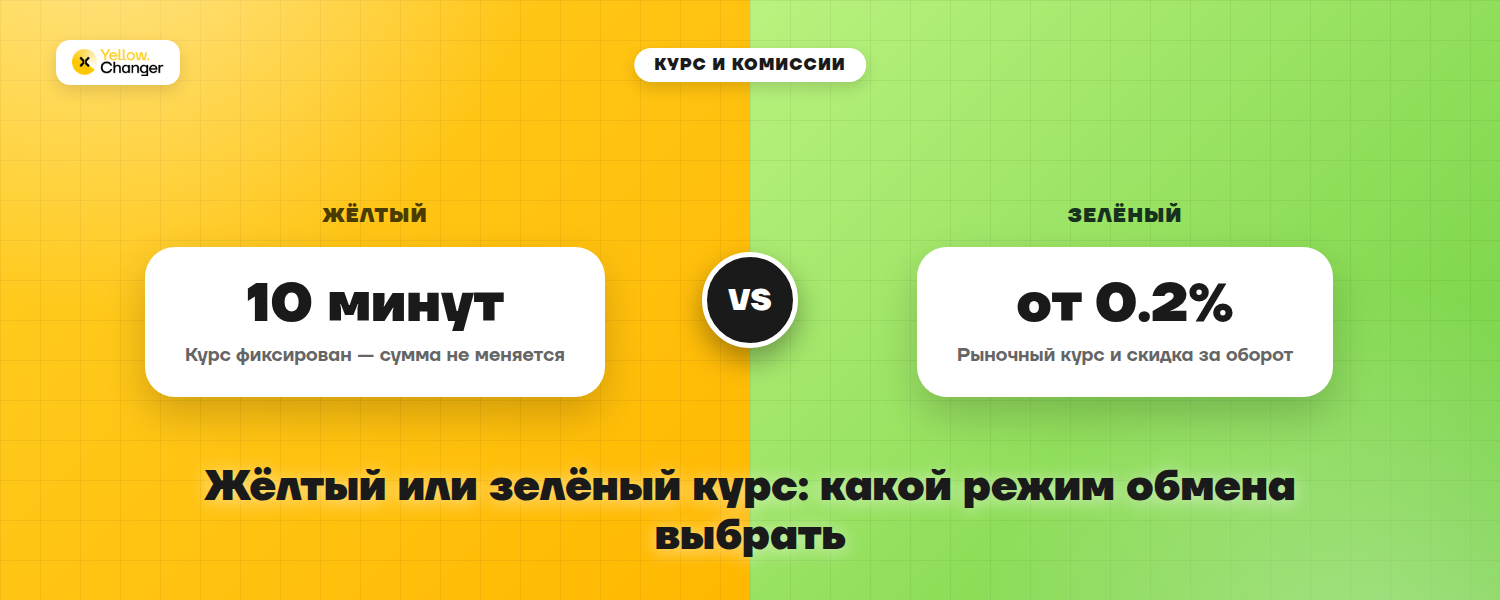
Yellow or Green Rate: How to Choose an Exchange Mode on YellowChanger
Aug 10, 2026
The difference between a rate locked for 10 minutes and a floating market rate — with current fees and a clear logic for picking between them.
AML Instead of KYC: Why a Crypto Exchanger May Not Ask for a Passport
Most crypto exchangers, YellowChanger included, don't ask for a passport on every trade — instead of checking who you are, they check the address the transfer came from. That's an AML check, and it works on different logic than the KYC you'd expect from an exchange: a decision based on specific risk thresholds, not on whether you've registered an account.
How AML differs from KYC
KYC — know your customer — verifies the person. It's usually required before the first trade: upload a document, sometimes a selfie holding it, wait for review, and only then get access to trading. That's the standard on centralized exchanges.
AML — anti-money laundering — checks the money, not the person. On YellowChanger the object of the check is the sender's address, and the check happens not before but at the moment an already-created order is processed. Different targets, different timing — which is why the user experience differs too: KYC demands upfront action, AML normally isn't noticeable at all.
How the address risk score works
The sending address gets a risk score from 0 to 100% from independent AML analytics providers — the same kind used across the industry, not some in-house metric. If the risk doesn't exceed 70% and the share of 'red' (flagged) marks on the address doesn't exceed 0.1%, the order is processed fully automatically. That covers the vast majority of exchanges.
The check on YellowChanger isn't run on the user — it's run on the specific address the transfer came from, and in the vast majority of cases it finishes without a human on either side.
What happens if an address lands in the risk zone
When either threshold is exceeded, the service may suspend the order for extra review. In some of those cases it may ask for an identity document — a photo or video holding it, a screenshot of the exchange or wallet account the transfer was sent from, or other information about the source of funds. But even then, returning the sent funds to the sender's own address is usually possible without going through full verification — this is where the AML model departs from the usual KYC logic: landing in the risk zone doesn't automatically mean funds are locked until a passport is produced.
Why this isn't the same as mandatory exchange KYC
On a centralized exchange, verification is a precondition for trading at all, regardless of any specific address's history — without completed KYC you simply can't place an order. An AML-based model works the other way around: it checks the hygiene of a specific transfer at the moment of exchange, not the identity of the person beforehand. The same logic applies to fiat off-ramps — for the USDT (TRC20) → rubles via SBP pair, the sender's address goes through the same AML check as any crypto-to-crypto exchange, with no separate identity form required before the trade.
Can you check an address in advance
Yes. Before sending a transfer, you can check your own address through BestChange's public AML tool — at any time, before or after the transfer. The sources and lists that tool uses are considered valid for the service's risk model, including the Chainalysis OFAC Sanctions List and other lists aligned with FATF recommendations and OFAC requirements. The check is optional and doesn't replace the service's own screening on receipt, but it lowers the odds an order gets held.
AML vs KYC, in short
KYC verifies a person's identity, usually before the trade and with a mandatory document.
AML on YellowChanger checks the address and origin of a transfer at the moment the order is processed, with no document for the vast majority of exchanges.
The automatic-processing threshold: address risk no higher than 70% and 'red' marks no higher than 0.1%.
Crossing the threshold means a hold for review, not a block — a refund to the sender's own address is usually available without full verification.
Frequently asked questions
Do I need to verify my identity to exchange crypto on YellowChanger?
No — for the vast majority of orders, KYC isn't required; an automatic AML check on the sender's address handles it. A document may only be requested in specific cases where the address risk score exceeds the set thresholds.
What does it mean if my order is 'stuck' under review?
It most likely means the sending address received an elevated risk score and the service paused processing for extra review. It doesn't mean your funds are lost — it's usually resolved with a refund, or in rarer cases a document request.
Is it true that suspicious activity gets your funds blocked outright?
No. Crossing a risk threshold suspends the order for review, it doesn't block it unconditionally — a refund to the sender's own address is usually possible in those cases without going through full identity verification.
How can I check in advance whether my address is 'clean'?
You can check your address through BestChange's public AML tool before sending — it's optional, but it lowers the risk of your order being held.
What's the core difference between AML and KYC, in plain terms?
AML checks the money and its trail, KYC checks the person. The first can go unnoticed by the user, the second always requires upfront action.